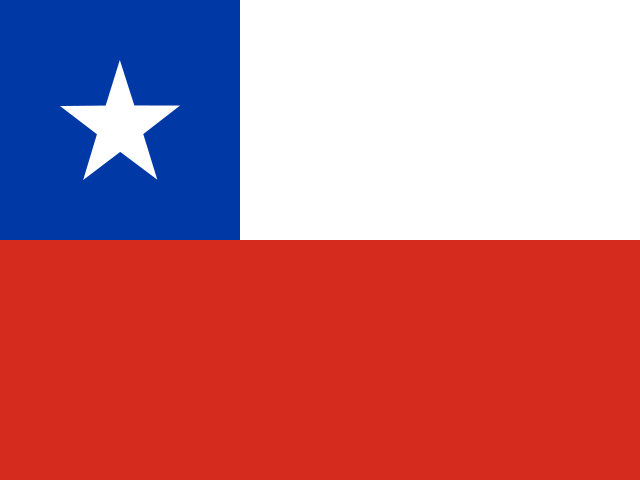
Aysén
A city in Chile, known for natural beauty and safety.
Photo by Micael Sáez on Unsplash
Coyhaique gets 148 sunny days a year. Winters are cold with frequent frost. Monthly cost of living for a solo adult is around $1,839 — among the most expensive in Latin America. Coyhaique scores highest in nature access and safety. On the other hand, air quality is a concern and food & dining score below average.
Coyhaique, Chile runs about $1,839/mo for a balanced lifestyle, logs 148 sunny days a year, and scores 72% on our safety composite across 52K residents.
Find your city match in 5 minutes
Take the quizFeels-like °C
Dinner outside
Cost of Living
monthly · balanced lifestyle · solo living
Feels-like °C
Dinner outside
Cost of Living
monthly · balanced lifestyle · solo living
Mobility
Culture
Nature & Outdoors
Air Quality
Safety
Career
Social & Community
Food & Dining
Family
Healthcare
PM2.5 annual average of 37.5 µg/m³ exceeds the WHO interim target of 15 µg/m³. The WHO guideline value is 5 µg/m³.
Data sources: WHO (air quality), OECD (safety).
As a small Patagonia town, Coyhaique's compact center lets expats walk to groceries, banks, and cafés in 10-15 minutes, but limited sidewalk continuity and windy, cold weather make routine pedestrian errands inconsistent outside the core.
Residential areas spread out require occasional driving for full daily needs, limiting full car-free living.
Expats can opt for the walkable downtown but face practical challenges from sparse infrastructure in a harsh climate.
Poor fit
Coyhaique is a remote Patagonian city with virtually no formal public transit system.
Local minibus services exist informally but are unreliable and sparse, and most mobility depends entirely on private vehicles or ride-hailing; transit infrastructure is negligible for relocating residents.
In remote Coyhaique, all routine car trips like errands or drop-offs complete in under 10 minutes due to the small population and sparse layout, maximizing free time for outdoor adventures as a newcomer.
Extremely low traffic and instant parking availability eliminate any driving friction.
Long-term, this exceptional efficiency defines a liberating Patagonian lifestyle, where the car serves essentials effortlessly.
Coyhaique experiences long, cold winters with regular snow and icy conditions across multiple months, and the rugged local roads and limited rental infrastructure make two-wheeled daily commuting uncommon and inconvenient.
While technically possible in good weather, the seasonal severity and limited foreigner-friendly rental/insurance options mean most residents would not rely on a scooter as primary transport.
Coyhaique has minimal cycling infrastructure despite its small size.
Bike lanes are virtually nonexistent, and cycling safety is compromised by narrow, busy streets without dedicated space.
The mountainous terrain, variable weather, and lack of systematic infrastructure investment make cycling impractical as daily urban transport; it remains restricted to local recreational riding.
The over 100-minute drive to the international airport represents a major time commitment, challenging expats who travel frequently for family or business and requiring extensive advance planning.
This remoteness limits spontaneous trips, impacting quality of life for those reliant on air connections in Patagonia.
Long-term relocation suits those with infrequent travel, as regular international access feels burdensome.
Coyhaique's airport serves only domestic routes with no scheduled international flights, leaving residents fully reliant on Santiago for global connections.
Expats face extreme travel barriers, where even regional South American trips require lengthy domestic flights first, disrupting work-life balance and family ties.
This disconnection makes long-term living appealing only if international travel is rarely needed, otherwise posing a substantial quality-of-life compromise.
No meaningful low-cost airline presence exists, with only full-service flights to Santiago making regional and international travel expensive and infrequent for expats.
This severely limits budget-friendly options, turning trips into significant expenses that deter regular escapes from remote Patagonia.
Long-term relocation here compromises travel freedom and elevates overall mobility costs, isolating residents from affordable exploration.
Coyhaique is a small city in remote Patagonia with no established art museums or significant galleries.
The absence of institutional art infrastructure makes it unsuitable for expats prioritizing access to formal art collections and cultural programming.
Coyhaique has minimal dedicated history museum infrastructure beyond small local exhibits.
As a smaller regional city, it lacks the institutional density and resources to support comprehensive historical interpretation, offering limited opportunities for deep cultural and historical exploration.
Coyhaique is a comparatively young, frontier-era city with a small stock of early 20th-century timber buildings and a regional museum, but it lacks major protected landmarks or a concentrated historic core.
Heritage presence is limited to a handful of local historic buildings and minor sites.
Coyhaique lacks any notable theatre or performing arts scene, leaving expats without local options and emphasizing its remote, nature-centric lifestyle.
This absence can heighten feelings of cultural isolation for arts-dependent individuals considering permanent relocation.
Newcomers must prioritize outdoor adventures over performing arts, reshaping expectations for entertainment and community building.
Coyhaique is a remote Patagonian city with minimal cinema infrastructure—typically one small theater with dated equipment and very limited showtimes.
The city lacks access to film festivals, international content, or art-house programming, making it highly restrictive for film-oriented residents.
Coyhaique is a small capital city in Chilean Patagonia with virtually no live music venue infrastructure or programming.
The city lacks dedicated music venues, regular performances, and the critical population mass needed to support any meaningful scene.
Live music is essentially absent from daily city life, and a music lover would find no regular access to performances.
Coyhaique has very limited and infrequent live music events due to its remote location and small population base.
The city lacks established venues, consistent programming, and touring artist infrastructure, making regular live music attendance unrealistic for relocators seeking an active cultural scene.
Coyhaique has very few bars with early closures around midnight and no notable clubs or late-night entertainment.
Nightlife plays minimal role in local culture, centered on quiet evenings rather than social venues.
Expats prioritizing regular bar and club outings will face severe limitations, impacting long-term social life in this remote, low-key Patagonian setting.
Coyhaique is deep inland in northern Patagonia with the nearest Pacific coastline many hours away by road (well over 2 hours and typically a full‑day journey to fjords/coastal towns).
The sea does not feature in daily life and is not practically accessible for routine visits.
Coyhaique lies in a Patagonian valley surrounded by steep Andean ranges with prominent peaks and rugged alpine terrain minutes to a short drive from town, so mountains are a defining visual and recreational feature.
The immediate proximity of diverse mountaineering, trekking and backcountry-ski terrain makes the city a clear choice for someone prioritizing mountains.
Coyhaique lies in a Patagonian valley where riparian and Nothofagus-dominated forests occur in the surrounding hills and along river corridors; medium-quality forest stands and access to larger forested areas are typically within a 10–20 minute drive.
The town mixes open steppe and forest patches, so forest access is good though not always large contiguous lowland rainforest.
Coyhaique’s small urban footprint, plazas and tree-lined residential areas provide broad access to green spaces and many residents are within a 10–15 minute walk of usable parks or vegetated edges.
There are fewer very large destination parks inside the built area, but the city’s layout and canopy give strong everyday access to green space.
Coyhaique sits in a river valley (Simpson and other tributaries) and is surrounded within tens of kilometres by numerous Patagonian rivers and lakes, offering ready access to clean freshwater for fishing, rafting and boating.
The regional river-lake network is extensive and of high ecological quality, making freshwater recreation widely accessible.
Immediate access to mountain trails, gravel roads and the Carretera Austral corridor gives excellent scenic trail-running choices right outside town, with many long natural-surface options.
Urban sidewalk networks are limited and seasonal snow/wet conditions reduce paved, year‑round running in the city itself, so usability is good but uneven.
Gateway to rugged Aysén backcountry with steep valleys and peaks reachable within roughly 30–90 minutes, offering dramatic terrain, river valleys and plentiful day- and multi-day routes for serious hikers.
Some marquee long-distance Patagonian treks require additional travel, and winter snowfall limits certain high routes, but overall trail variety and quality near town are strong.
Coyhaique is a central hub in Northern Patagonia with immediate access to vast wilderness, national reserves and multi‑day backcountry routes (many sites within 0–100 km), offering abundant car‑camp and remote camping opportunities.
The surrounding region is widely used for extended wilderness camping and outfitting, making it known for high‑quality, plentiful camping.
Coyhaique is an inland city in the Aysén region with the Pacific coast several hours' drive away (typically well over 4–6 hours), so coastal beaches are not accessible for routine after-work or weekly visits.
Local outdoor life focuses on rivers, lakes and mountains rather than a beach-oriented lifestyle.
Coyhaique is an inland city in Aysén; the Pacific coast is many hours away (typically a multi‑hour, often full‑day drive), so ocean surfing and coastal watersports are not practical for regular use.
Local activity focuses on rivers and lakes rather than ocean/coastal conditions.
Coyhaique is an inland Patagonian city in the Aysén region with no immediate marine coastline; the nearest ocean access requires long overland travel so marine scuba/snorkel is occasional for residents.
There are some freshwater lake and river dive possibilities in the region, but opportunities are sparse and generally low-quality for routine snorkeling.
Coyhaique is in a remote Patagonian zone with limited commercial resort infrastructure; most alpine activity is small local operations or backcountry skiing, and the nearest larger maintained resorts require long travel.
For long-term newcomers, consistent, serviced resort skiing is limited and generally distant.
The Aysén region around Coyhaique provides real alpine and rock objectives, but most accessible crags and mountain routes tend to sit around 60–120 minutes from town (examples include nearby valley and reserve areas reachable by a one–two hour drive).
Good climbing exists, yet much of it requires longer drives or more remote approaches rather than immediate short-distance access.
This remote Patagonian hub offers expats effortless walking at any hour across its compact layout, with street crime effectively zero and strong community vigilance ensuring unremarkable safety for all activities.
Women stroll alone late at night without a second thought, reflecting deep public order that eliminates lifestyle limits.
Long-term relocation here means safety bolsters the pristine, outdoor-focused quality of life as a non-issue.
In this remote Patagonian setting, property crime is very low, with rare opportunistic thefts even in smaller commercial zones, enabling expats to live with high confidence in neighborhood safety.
Residential break-ins or vehicle crimes are exceptional, aligning with rural trust levels.
The minimal vigilance required enhances quality of life, making long-term stays feel secure and unburdened by urban risks.
Coyhaique is a smaller, remote city in Chile's Patagonia region with limited infrastructure and higher accident severity due to geographic isolation and harsh weather.
Road conditions are often poor, and driver behavior is less regulated than in larger cities; emergency services response times are longer, making injuries more life-threatening.
The combination of isolated location, weather hazards, and minimal pedestrian infrastructure creates elevated risk for long-term residents.
Coyhaique is in southern Chile where seismicity exists but is generally less frequent and less intense than the coastal megathrust zone; felt earthquakes occur but damaging events are rarer, so shaking is an intermittent—not constant—part of life.
Local infrastructure is built with national seismic design standards in mind, so for a relocating expat earthquakes are a prudent awareness rather than a daily reality.
Coyhaique lies in a Patagonian forest/steppe mosaic where summers can be drier and produce isolated fires, but large destructive fires near the city are uncommon and smoke impacts are typically occasional and limited.
Standard seasonal awareness and basic preparedness are advisable for long-term residents.
Coyhaique lies in an interior valley along the Simpson River and experiences seasonal precipitation and snowmelt, but urban flooding is infrequent and generally confined to riverbanks or specific low-lying streets.
Disruptions are occasional and typically short-lived, so most daily routines are not regularly affected.
In remote Coyhaique, expats encounter almost no cuisine diversity beyond hearty Patagonian meats and local produce, severely restricting food lovers' options in this rugged outpost.
Daily meals revolve around repetitive regional fare, with international varieties virtually absent, potentially frustrating long-term relocation for global palates.
The isolated neighborhoods amplify this limitation, prioritizing wilderness over culinary wanderlust.
Coyhaique's dining scene is limited and underdeveloped for a food lover, reflecting its small size and isolation in Patagonia; quality varies significantly and many establishments rely on basic preparation rather than culinary skill.
While local meat and some regional ingredients are available, the overall consistency and ambition of restaurants is low, with few standout venues offering compelling dining experiences.
Expats should expect modest dining options and frequent resort to casual or fast-food establishments.
Coyhaique has no meaningful brunch availability, with restaurants following strictly traditional Chilean meal schedules.
As a smaller regional city, the brunch concept is essentially absent from the local food scene.
Expats relocating here should not expect weekend brunch culture to be available.
Coyhaique has virtually no vegan or vegetarian restaurants.
As a small Patagonian city, dining options are extremely limited and primarily centered on meat and traditional regional food.
Plant-based expats would find essentially no restaurant support for their dietary preferences and would need to self-cater almost exclusively.
Coyhaique has minimal delivery infrastructure, with very few restaurants participating via informal or single-platform options, unreliable timing, and coverage confined to the small urban core.
Expats face slim choices mostly fast food, making it impractical for regular use on work nights or when ill.
This scarcity impacts relocation by necessitating self-reliance for meals, aligning with the remote lifestyle but limiting urban-style comforts.
Public healthcare in this remote Patagonian region is severely limited by geographic isolation and resource scarcity, making FONASA enrollment less practical for timely specialist care.
GP visits are accessible but specialists and diagnostics often require travel to larger cities (500+ km), creating de facto wait times of 4-8 weeks.
Language barriers compound access challenges, and facility quality is below national standards.
Newly arrived expats face genuine obstacles accessing public care and typically rely entirely on private insurance or medical tourism.
Coyhaique, as a remote Patagonian city, has minimal private healthcare resources—primarily small clinics without hospital capacity or specialist services.
Any serious medical needs require evacuation or travel to Puerto Montt or further south; English-speaking medical care is virtually nonexistent; and international insurance acceptance is unreliable.
Expatriates cannot depend on private healthcare for comprehensive care and would face significant vulnerability in medical emergencies.
Coyhaique is a small, remote regional capital with an economy dominated by public services, small-scale tourism and agriculture, and very limited multinational or private-sector professional hiring.
There are effectively no sustained pathways for English-speaking international professionals into local knowledge-economy roles, and typical time-to-hire for such work exceeds six months.
Coyhaique is a small, remote regional center whose economy is dominated by government services, primary production, fisheries and seasonal tourism, with minimal corporate or financial‑services infrastructure.
The limited diversification and small metro output place it in the low band for economic sophistication.
Coyhaique is a small, remote regional capital whose professional employment is concentrated in public administration, primary-resource activities (livestock/forestry) and tourism services.
The narrow set of private-sector industries means substantial career changes typically require relocation to larger regional centres.
Coyhaique is a remote, low-population regional center with mainly micro-entrepreneurship in tourism and primary industries; formal accelerators, local VCs, and angel networks are effectively absent.
The founder community is thin and there are no notable startup exits, making it a nascent ecosystem.
Coyhaique is a remote regional capital with a small, locally focused economy and at most a couple of international firms represented through supply-chain or logistics branches.
There are no large multinational offices or SSCs, so multinational career options are minimal.
Coyhaique has very limited dedicated coworking infrastructure (typically one to three small shared-work facilities or business centres) with constrained hours and minimal tier variety; while basic connectivity is available, the scarcity of spaces and limited professional amenities leave remote workers underserved.
A newcomer would likely need to rely on a small local space or other work arrangements for long-term productivity.
Coyhaique is a small, remote regional center with only occasional chamber meetings, municipal business forums, or sector gatherings tied to regional development; there is no steady rhythm of industry meetups or frequent corporate networking events.
Accessibility for internationals is low and building a professional network would generally require exceptional personal initiative.
Coyhaique is a small city of ~50,000 in Patagonia with minimal higher education infrastructure—primarily vocational and technical training centers rather than degree-granting universities.
The near-absence of a university ecosystem means anyone seeking degree programs, research engagement, or academic community culture would find very limited local options and would need to relocate to larger regional centers.
Coyhaique, as with the rest of Chile, has open access to major remote-work and developer platforms without the need for circumvention tools.
Short-term, targeted restrictions tied to civil unrest have occurred occasionally, but they are uncommon and do not generally affect the daily use of core productivity services.
Coyhaique (regional capital with a population on the order of tens of thousands) has limited tourism infrastructure and few English-speaking service workers; most clinics, municipal offices and local businesses operate only in Spanish.
English is generally confined to isolated tour operators or a handful of hotels, so an English-only resident would struggle with routine medical, banking and bureaucratic tasks.
Coyhaique, a remote city in Patagonia with a population under 50,000, has no dedicated international schools offering English-medium education with recognized curricula or accreditation.
Expat families relocating here have no viable local options for international education and would need to homeschool or send children to boarding schools in Santiago or Buenos Aires.
Coyhaique has limited public playground infrastructure reflecting its smaller size and regional status.
While some parks exist, playground density is low across residential neighborhoods, requiring families to plan trips rather than benefit from convenient daily access.
Equipment quantity and maintenance standards do not support consistent outdoor play for young children.
Coyhaique's geographic isolation and small population severely limit supermarket options, with few modern chains and inconsistent product availability across neighborhoods.
International products are extremely scarce, and fresh produce variety is constrained by supply chain limitations and distance from agricultural centers.
A relocating expat would face frustrating grocery shopping compared to developed-world standards, requiring advance planning for specialty items and accepting higher prices and limited selection as a permanent trade-off.
Coyhaique, a smaller Patagonian city, has virtually no major shopping malls or modern commercial centers, relying instead on dispersed local retail.
This remote location means expats will find severe shopping limitations and should plan accordingly for sourcing goods and entertainment beyond basic necessities.
Coyhaique appears to lack any documented specialty coffee culture, with no identifiable independent cafés, local roasters, or third-wave infrastructure.
For a relocating coffee enthusiast, the city offers virtually no access to quality specialty coffee experiences or work-friendly café spaces.
Coyhaique has very few gyms with rudimentary setups—minimal free weights and cardio—poorly maintained and restricted hours, deeply frustrating a serious fitness enthusiast unable to access proper strength or group training.
Neighborhood coverage is negligible beyond downtown, isolating most residents from viable options.
For expats eyeing long-term stays, this scarcity severely hampers building a sustainable gym-dependent lifestyle.
No data on team sports facilities or organized sports infrastructure in Coyhaique was found in recent sources.
As a smaller Patagonian city, it likely offers limited access to dedicated team sports halls, making it challenging for expats seeking structured competitive or recreational league participation.
Coyhaique, a remote Patagonian city, has no established wellness or spa facilities available locally.
Expats seeking regular spa and wellness services would face a complete absence of infrastructure, requiring relocation to access professional treatments.
Just 1-2 basic yoga studios exist with inconsistent schedules in remote Coyhaique, posing challenges for expats seeking regular practice in this Patagonia outpost.
Limited class types and accessibility restrict wellness options, pushing reliance on outdoor activities instead.
Long-term residents may find yoga supplemental at best, impacting routine health habits.
No indoor climbing gyms are documented for Coyhaique, a Patagonian hub on the Carretera Austral.
While the region offers exceptional outdoor hiking and adventure opportunities, the absence of gym infrastructure means climbers must rely entirely on outdoor climbing or travel for indoor training.
Coyhaique, located in Patagonia, has no documented public tennis or pickleball courts.
As a remote small city, court sports infrastructure is essentially nonexistent.
Residents interested in these sports would have no realistic local options for play.
Coyhaique, a remote Patagonian town, has no padel infrastructure.
The sport is unavailable, and there is no established community or facilities for players.
No martial arts facilities, gyms, or fitness centers were identified for Coyhaique.
As a remote Patagonian city, it appears to have no infrastructure for martial arts training, making it unsuitable for those seeking regular access to organized classes or facilities.
Social & Community Profile
Social life in Coyhaique is subdued. Expat integration can be challenging, and learning the local language helps.
Community & Vibe
Urban atmosphere and local social life
Urban Energyin CoyhaiqueLow
in Coyhaique
Coyhaique maintains a very calm, small-town rhythm with minimal pedestrian traffic outside central markets and rare local fairs, emptying early without nightlife options. A relocating expat desiring urban stimulation would likely feel isolated in the sparse public activity, though the tight-knit community adds warmth to daily routines. This low energy prioritizes Patagonia solitude over city buzz in long-term living.
Street Atmospherein CoyhaiqueLow
in Coyhaique
Coyhaique's remote streets feel very orderly and quiet, with residents keeping to themselves amid vast Patagonian surroundings and minimal public spontaneity. Long-term expats experience a structured, low-key daily life focused on nature over street interactions, which can foster solitude but limit community energy. This suits introverted lifestyles prioritizing peace, though it may challenge those seeking vibrant social textures.
Local-First Communityin CoyhaiqueModerate
in Coyhaique
Coyhaique offers limited documented evidence of established expat communities or specific local-newcomer integration dynamics. As a smaller, more remote Patagonian city without the tourism or wine-culture infrastructure of Puerto Varas or Mendoza, integration likely proceeds slowly and requires higher Spanish proficiency and independent effort to build authentic local connections.
Multicultural Mixin CoyhaiqueLow
in Coyhaique
Coyhaique is a small regional Chilean city with an overwhelmingly homogeneous population reflecting Patagonian demographics, with minimal documented immigrant communities or international presence. As a remote administrative and service center, the city lacks established multicultural neighborhoods or visible cultural diversity that would meaningfully affect expat lifestyle or community integration.
Expat Life
Expat community, integration, and immigration policy
Expat Integration Experiencein CoyhaiqueModerate
in Coyhaique
Coyhaique is a small, isolated Patagonian city where the tight-knit local community is less accustomed to foreign residents and social bonds are predominantly formed through long-established networks. Spanish fluency is mandatory as English proficiency is very low; bureaucratic processes are more cumbersome in smaller cities. Expats face a steep and prolonged integration curve; those who stay 2+ years and become fluent in Spanish can eventually be accepted, but most will feel like permanent outsiders for the first 18-24 months or longer.
Expat-First Communityin CoyhaiqueNone
in Coyhaique
Coyhaique lacks any meaningful expat community, with foreigners extremely rare in this remote Patagonian outpost, leaving newcomers entirely isolated among internationals. Long-term relocation here means no reliable path to expat social circles, profoundly impacting quality of life through persistent solitude despite natural beauty. Social life centers solely on locals, with zero organized international support.
Government Immigration Friendlinessin CoyhaiqueGood
in Coyhaique
National Chilean visa options and residency routes exist and the central application systems are functional, but Coyhaique's remoteness means fewer in-person appointment slots, occasional longer waits for local registrations and limited English support, increasing the practical friction for newcomers. The system is usable and not closed, but the added regional logistical delays make it less smooth than in larger Chilean cities.
Language
English support for daily life and administration
Everyday Englishin CoyhaiqueLow
in Coyhaique
Coyhaique (regional capital with a population on the order of tens of thousands) has limited tourism infrastructure and few English-speaking service workers; most clinics, municipal offices and local businesses operate only in Spanish. English is generally confined to isolated tour operators or a handful of hotels, so an English-only resident would struggle with routine medical, banking and bureaucratic tasks.
Admin English Supportin CoyhaiqueLow
in Coyhaique