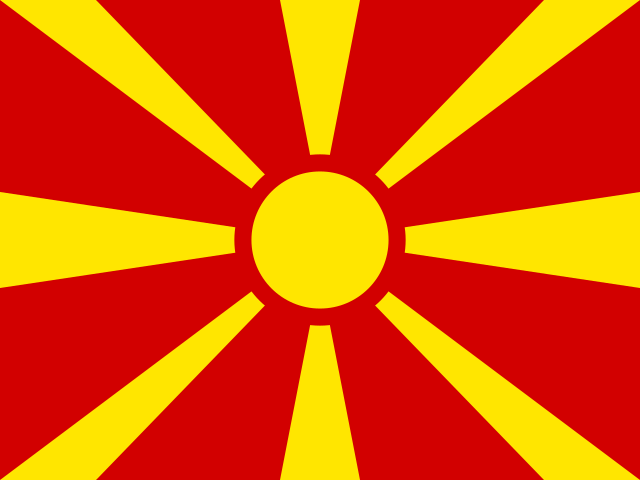
Grad Skopje
The capital and largest city of North Macedonia, known for natural beauty.
Photo by Fajar Al Hadi on Unsplash
Skopje enjoys 220 sunny days a year, with frosty winters and limited daylight. Monthly cost of living for a solo adult is around $894 — one of the most affordable cities in Europe. Skopje stands out for its nature access. On the other hand, food & dining score below average and learning the local language is important for daily life.
Skopje, North Macedonia runs about $894/mo for a balanced lifestyle, logs 220 sunny days a year, and scores 45% on our safety composite across 403K residents.
Find your city match in 5 minutes
Take the quizFeels-like °C
Dinner outside
Cost of Living
monthly · balanced lifestyle · solo living
Feels-like °C
Dinner outside
Cost of Living
monthly · balanced lifestyle · solo living
Mobility
Culture
Nature & Outdoors
Air Quality
Safety
Career
Social & Community
Food & Dining
Family
Healthcare
PM2.5 annual average of 20.5 µg/m³ exceeds the WHO interim target of 15 µg/m³. The WHO guideline value is 5 µg/m³.
Safety score of 2.2 out of 5 is below the midpoint threshold. Consider researching specific neighborhoods and recent trends.
Data sources: WHO (air quality), OECD (safety).
Central Skopje provides basic access to groceries, pharmacies, and services within 15 minutes in pedestrianized areas with decent sidewalks, allowing some expats to manage errands on foot.
Inconsistent infrastructure, uneven pavement, and car-heavy traffic in residential zones reduce safety and comfort for daily walking.
Hot summers slightly limit comfort but do not fully prevent routine pedestrian use in core neighborhoods.
Expats in Skopje can use the extensive bus system for central commutes and errands with reasonable daytime service, but inconsistent punctuality and poor coverage in suburbs limit its role as a primary mobility option.
Evening services taper off quickly, restricting social activities without a car.
This basic setup allows car-optional living downtown but makes outer expat areas feel isolated, affecting overall convenience and spontaneity in daily life.
Skopje's relatively compact size offers shorter nominal distances (many destinations within 5–20 km), but heavy congestion during peak hours extends actual commute times to 30–50 minutes for typical trips.
Parking infrastructure is limited, particularly near employment and retail centers, creating additional delays and stress.
Air quality concerns and uneven road conditions add to driving friction; relocators should expect significant daily time-loss despite the city's small geographic footprint.
Skopje has moderate local scooter and small‑motorbike use and a functioning rental/used‑vehicle market accessible to foreigners, making two‑wheelers a viable secondary transport option for many daily trips.
Seasonal snowfall and some uneven road surfaces in winter (roughly December–February) plus occasional busy intersections mean newcomers often combine scooters with other transport modes rather than relying on them exclusively.
Skopje has virtually no integrated cycling infrastructure suitable for urban transport.
The city lacks protected bike lanes, widespread bike parking, or bike-share systems.
Traffic is heavily car-oriented with poor cycling safety at intersections and major roads.
While some residents may cycle on side streets, there is no coherent network connecting residential areas to employment centers or services, making cycling impractical for daily commuting.
A 25-minute typical drive to Skopje International Airport from the city center enables expats to handle regular international trips efficiently, with minimal disruption to daily life.
Predictable timing under normal conditions makes it suitable for business travelers or those visiting family abroad.
This convenience positively impacts long-term living by facilitating easy maintenance of global ties.
With under 20 direct international destinations mostly to nearby Balkans and Europe, expats struggle to fly direct to major global cities or distant family homes.
Infrequent services amplify the need for connections, increasing travel fatigue for business professionals or those with overseas ties.
This setup limits spontaneous travel and heightens the sense of peripheral location in one's long-term lifestyle.
Multiple budget carriers like Wizz Air provide consistent routes to key European spots from Skopje, empowering expatriates with affordable, frequent options for regional travel that fit varied schedules.
This fosters a dynamic lifestyle where spontaneous short trips are feasible without high costs, easing homesickness and boosting weekend adventures.
The network supports sustained quality of life for newcomers by keeping mobility expenses low amid daily routines.
Skopje has the Museum of Contemporary Art and National Gallery of Macedonia, but both institutions operate with limited permanent collections and infrequent international exhibitions.
The art scene is modest and regionally focused, providing some cultural infrastructure but insufficient depth for those seeking a vibrant museum-going lifestyle.
Expats in Skopje find regional history museums covering Ottoman antiquities and Balkan antiquity reconstructions, providing context for the city's eclectic skyline and identity.
This setup enables occasional enriching visits that enhance understanding of local pride, though variety is constrained for ongoing engagement.
It fits a practical expat routine with light cultural integration.
Skopje's Old Bazaar, Stone Bridge and Kale Fortress are notable historic assets and the city retains visible Ottoman- and medieval-era elements, but there is no major World Heritage listing and recognition is mostly regional.
Preservation and presentation vary across sites, giving a modest but tangible heritage offering.
Skopje's theatre scene gives expats access to a few venues with regular local plays and dramas, supporting consistent if limited cultural participation in daily life.
Residents benefit from these options for affordable evenings out, though variety remains narrow, suiting moderate interest without fulfilling dedicated theatre-goers' needs long-term.
It contributes steadily to a balanced expat lifestyle in the Balkans.
Skopje operates a few cinemas with modern screening technology but limited showtime variety and predominantly mainstream content in dubbed formats.
Original-language and art-house films are rarely available, and the cinema culture remains underdeveloped compared to larger European capitals.
This limits cultural options for expats seeking diverse film programming.
Skopje's modest scene includes several bars and halls with regular local performances in rock, pop, and Balkan folk, allowing music lovers to catch shows a couple times monthly.
Limited high-quality venues and genre diversity restrict the vibrancy, with few touring artists beyond regional acts.
Relocators would appreciate the accessible local energy but find it lacks depth for frequent, multi-genre immersion.
In Skopje, expats find bi-weekly live music at bars and occasional festivals with modest setups across folk and pop, offering predictable but limited engagement opportunities.
This supports occasional nights out that aid social integration without overwhelming schedules, though the narrow genre range may frustrate those craving broader variety over years.
It contributes to a balanced but not exceptional cultural life.
Skopje features a modest cluster of bars and clubs around Debar Maalo that operate Thursday to Saturday past 2am, enabling weekend socializing for relocating nightlife fans.
Options lack diversity and geographic spread, with most action weekend-only, meaning expats can enjoy it sporadically but not as a core routine.
Central areas feel safe enough for regular use, supporting a functional but unremarkable experience.
Skopje is landlocked and the nearest open-sea coast (Aegean/Adriatic) requires a multi‑hour drive of roughly 3+ hours (several hundred kilometres).
The sea is not part of everyday life for residents.
Vodno (≈1,066 m) sits immediately above the city (≈10 km, ~15–30 min by road) and is a focal recreation area for hiking and climbing; larger ranges (Jakupica/Šar region) lie within roughly 60–120 km for longer trips.
The presence of an immediately adjacent 1,000+m mountain and several additional ranges within a short drive gives strong, integrated mountain access.
Forested Vodno mountain and surrounding wooded hills lie within or immediately adjacent to the urban area, reachable within roughly 0–20 minutes from central districts, providing medium-sized forest stands for recreation.
Larger canyon and mountain forests (e.g., Matka and foothills) sit a little farther out but still within short drives.
Skopje has several notable riverside and hillside parks and tree-lined sections that serve parts of the city, offering usable green space for residents.
Distribution is uneven across the built-up area so while some neighborhoods are well served within a 10–15 minute walk, others—especially peripheral districts—are not, and park quality is mixed.
Skopje is bisected by the Vardar River and lies close to the Treska River and Matka Canyon (a reservoir and canyon ~15–20 km from the centre) offering boating and canyon access.
The city therefore has good river access and a nearby lake/reservoir for day recreation, though the number of distinct waterbodies is moderate rather than extensive.
Skopje features several kilometres of continuous riverfront promenades along the Vardar and linked park systems, plus hill and fortress trails and nearby canyon/nature options for longer runs.
Infrastructure is generally coherent and safe for runners, with a mix of paved embankments and softer park trails, so it provides excellent urban running with good route variety.
Good hiking is available within about 30–60 minutes (Vodno and Matka Canyon provide steep trails, gorges and ridge routes), offering several solid day-hike options and moderate elevation.
The overall network is decent for regular activity, but the most extensive high-mountain systems are farther away and options can be exhausted faster than in true mountain hubs.
Matka Canyon is about 15 km from the city and offers outdoor camping and water-access spots, and Mavrovo National Park lies roughly 70–90 km away with established campsites.
Multiple accessible camping locations are available within 1–2 hours, giving good regional options though not an exceptionally dense campground network immediately adjacent.
Skopje is landlocked with the nearest seaside several hours away by road, so coastal beaches are not accessible for regular use.
While there are rivers and reservoirs, the city lacks a coastal beach culture suitable for a beach-focused daily or weekly routine.
Skopje is landlocked with the nearest sea several hundred kilometres away and drive times well over two hours, so regular ocean surfing or coastal watersports are not practically accessible for residents.
Local watersports are limited to lakes and rivers.
Skopje is landlocked; the nearest marine coast is several hours’ drive (Lake Ohrid and other freshwater bodies are the closest regular dive locations, ~2–3 hours by road).
Freshwater dive sites exist but are limited in number, infrastructure, and visibility, so marine-style scuba/snorkeling options are occasional rather than routine.
Several established ski areas (for example in the Šar and Bistra/Mavrovo ranges) are reachable within roughly 1–2 hours, offering full alpine infrastructure and multi-run resorts.
That level of access provides good, regular skiing opportunities within reasonable travel for long-term residents.
High‑quality and varied climbing is very close to the city: Matka Canyon is about 15–30 minutes away with extensive limestone sport and multi‑pitch lines, and nearby mountain ranges provide additional trad and alpine options within short drives.
The proximity and diversity of sectors make the area a strong, locally diverse climbing region.
In Skopje, expats find daytime walking safe nearly everywhere in typical residential areas, with pickpocketing more common than assaults.
At night, central districts are manageable for solo outings, though women may prefer groups in peripheral spots, imposing mild rather than dominant safety adjustments.
Overall, street risks do not significantly hinder daily commuting or socializing long-term.
Skopje reports noticeable levels of petty property crime including pickpocketing and phone-snatching in busy areas, along with vehicle break-ins and occasional bike theft.
Home burglary occurs at moderate rates in some neighborhoods but is not endemic; violent property crime is rare.
Relocating expats should adopt daily vigilance around public spaces and protect belongings during transit, but security bars and alarm systems are not standard or necessary for residential safety.
Skopje's road safety concerns newcomers with above-average death risks from erratic driving culture and uneven pedestrian infrastructure, necessitating significant adaptations like avoiding dusk crossings or certain arterials.
Cyclists and walkers encounter gaps in bike lanes and aggressive vehicle priority, impacting routine errands.
Driving or taxis requires learned local habits for safer long-term residency, though central areas offer moderate predictability.
Skopje sits in a seismically active part of the Balkans with a history of a major destructive earthquake in the 20th century, but frequent M4+ shaking is not the norm in the city center.
Post‑event reconstruction improved standards, yet the historical precedent means earthquakes are an intermittent concern rather than a constant part of daily life.
Skopje is surrounded by dry, vegetated hills that experience seasonal wildfires during hot summers, causing periodic smoke and localized firefighting operations.
While large, city-threatening conflagrations are uncommon, some preparedness and attention to seasonal fire warnings are advisable.
Skopje lies along the Vardar River but benefits from embankments and river channel works that keep major inundation rare; flood impacts are normally confined to specific low‑lying floodplain pockets.
Infrequent events may cause short‑term disruptions in those areas but do not typically alter daily routines across the city.
A food-loving expat in Skopje can access modest international fare including Italian, Chinese, and Turkish alongside Macedonian grilled meats, supporting varied family meals a few times a week.
Limited authenticity and few specialty spots mean long-term residents may tire of the narrow range, with variety clustered in central areas rather than evenly spread.
This allows basic global exposure but misses deeper culinary immersion.
Expats in Skopje encounter a varied dining scene where tavče gravče and ajvar highlight Macedonian roots in neighborhood grills, yet many casual venues deliver mediocre execution, making standout meals effort-dependent.
Fresh local produce supports solid basics, but culinary ambition is limited citywide, with average spots rarely impressing.
Long-term, this means comfortable but unexciting food exploration, where a food enthusiast might crave more reliable excellence in daily life.
Skopje has very limited brunch availability with only a few cafés and restaurants offering brunch service, primarily in the city center.
Brunch is not an established cultural tradition, and options are sparse with inconsistent service quality.
Skopje provides very limited dedicated vegan or vegetarian restaurants, making it tough for expats to dine out confidently on plant-based meals regularly.
The scarcity forces frequent home cooking in a grill-centric food scene, potentially straining social and exploratory eating experiences over time.
Reliability and distribution are low, hindering effortless integration into local life.
Skopje's delivery scene features a couple of platforms with mostly chain restaurants and fast food, offering patchy neighborhood coverage and variable 40-50 minute times that frustrate busy expat schedules.
Variety is thin, limiting cuisine exploration without pickup, and late-night options are unreliable.
For relocation, this means basic support for workdays but frequent cooking to maintain dietary diversity over time.
North Macedonia's public healthcare system is fragmented and unreliable for expats.
Eligibility is tied to employment or residency; enrollment is slow and bureaucratic; facilities are outdated; and English-speaking staff is rare outside emergency units.
Specialist care is severely delayed (often 3-6+ months); medications are frequently unavailable; and quality of care is inconsistent.
Expats are effectively forced to use private healthcare, as the public system cannot deliver timely or reliable care even in emergencies.
Skopje's private sector provides several clinics and a small hospital for routine and intermediate care with reduced waits, but rare specialties require travel elsewhere.
English-speaking doctors exist in key spots, yet international services are basic, occasionally hindering smooth care coordination.
This level supports daily health management for expats but limits assurance for ongoing complex needs, shaping a cautious approach to long-term settlement.
Skopje hosts manufacturing, shared-services centres and an emerging tech scene with several international employers and call-centre operations that hire English-speaking staff.
Skilled professional roles are available on a regular basis but competition and local language preferences mean a typical time-to-hire is roughly 2–4 months for qualified foreigners.
Skopje is the primary economic hub of North Macedonia with manufacturing, public administration and service sectors and an identifiable business district, but it lacks the breadth of multinational headquarters and deep knowledge clusters found in larger regional centres.
The professional‑services ecosystem exists at a basic level, consistent with an emerging, modestly diversified metro economy.
Skopje combines government/public administration, manufacturing and engineering, wholesale/retail and logistics, education and healthcare, construction, and a growing IT/services sector.
While multiple meaningful sectors exist and offer alternatives for professionals, employment still clusters around a few traditional industries so diversity is moderate rather than extensive.
Skopje hosts a small startup community with university-linked incubators, periodic accelerator programs and local meetups, yet meaningful local VC activity and significant exits are limited.
Founders can start and prototype locally but typically need outside capital for larger growth stages.
Skopje hosts several foreign banks, telecoms and a modest number of international firms and service operations, providing some multinational employment but in a relatively narrow set of sectors.
Overall the city has only a limited pool of large multinational employers (near the lower end of the 5–15 range).
Skopje has about 4–10 dedicated coworking spaces concentrated in the city center and near academic/tech clusters, offering adequate internet and basic meeting rooms.
Variety across price tiers and 24/7 access is limited, and community programming is intermittent, so a remote worker can function but will face few alternatives across neighborhoods.
Skopje hosts university-led industry panels, periodic trade missions, and monthly IT/entrepreneurship meetups, and the chamber of commerce is active, but the overall volume and international orientation are limited.
A motivated newcomer can connect to peers over time, but building a broad, cross-industry network takes longer than in larger hubs.
Skopje provides 2-4 institutions with coverage in medicine, law, and technical fields, though research is modest and English-taught options are rare, restricting expat participation in advanced studies.
Students contribute visible vibrancy to city centers through events and youthful neighborhoods, enhancing social life moderately.
Long-term residents seeking intellectual stimulation find adequate but not inspiring options, with trade-offs in program diversity and global accessibility.
North Macedonia allows unhindered access to major productivity and developer tools (Slack, Google Workspace, Zoom, GitHub, WhatsApp) without VPN and does not maintain systematic blocks on these services.
The overall experience is near friction-free for remote work, though formal digital-rights protections are less robust than in many EU member states.
English is visible in central commercial areas, universities, and tourist spots and some private clinics and banks have English-capable staff, but the majority of public healthcare, municipal offices and neighborhood-level services operate in Macedonian (and Albanian in parts).
An English-only speaker will manage in downtown settings but will need help or translation for routine bureaucratic and many residential matters.
Skopje offers only 1–2 small international schools with limited curriculum options and inconsistent accreditation.
Expat families relocating here would face constrained choices and potential waitlists, particularly for mid-year admissions.
Skopje's playground availability is concentrated in the city center and along the Vardar River developments, with sparse coverage in residential neighborhoods.
Maintenance standards are uneven, and equipment in peripheral areas shows age; families would typically need to walk 15-20 minutes or travel by car to reach well-maintained facilities.
The distribution does not support daily neighborhood-based outdoor play for most residents.
Skopje has moderate supermarket infrastructure with chains including Ramstore and Tinex providing coverage in central neighborhoods and growing suburban areas, offering adequate fresh produce and staple availability.
Product selection outside basic categories is limited, with scarce organic or premium imported goods; relocating expats will experience adequate but uninspiring grocery shopping with uneven quality and selection across different store locations and neighborhoods.
Skopje's main shopping venues include Ramstore and Karavan Mall, which provide basic retail services with limited international brand presence and modest entertainment amenities.
These centers serve local shoppers adequately but lack the modern design, extensive tenant variety, and dining sophistication that would significantly enhance the quality of life for long-term relocators seeking diverse shopping and leisure options.
Skopje has a few independent coffee shops concentrated in the city center, but the specialty coffee scene is limited and lacks established local roasters.
While some cafés may offer basic single-origin options, the geographic spread and work-friendly infrastructure for coffee enthusiasts remain minimal outside downtown areas.
Skopje has a limited gym market with basic facilities offering standard cardio and limited free weights, mostly concentrated downtown.
Equipment maintenance and facility cleanliness are inconsistent, and group fitness programming is minimal.
Gym-goers would face coverage gaps in outlying neighborhoods.
No search results provided information about Skopje's team sports halls or facilities.
Without verified data on sports centers or organized team sports infrastructure, a conservative community-level score reflects incomplete evidence.
Skopje has basic wellness facilities with a limited number of massage clinics and spa services available in central areas and hotels.
These venues operate reliably but offer narrow treatment menus and modest facilities, providing functional wellness options for occasional use without the depth or professional infrastructure of established spa destinations.
With only 1-2 basic studios featuring inconsistent offerings, expats face hurdles in establishing reliable yoga habits for ongoing fitness and relaxation.
Poor accessibility disrupts routine integration, compelling alternatives like online sessions that lack community feel vital for long-term expat adjustment.
This reflects a developing scene where wellness takes a backseat to everyday urban challenges.
Evidence suggests at least one small indoor climbing facility exists in Skopje, but details on quality and capacity remain limited.
The climbing community appears small, and options for regular training are likely constrained compared to larger Central European cities.
Skopje offers some tennis courts through sports clubs and municipal facilities, but access is limited and infrastructure development remains uneven.
Expats should expect a modest recreational scene without the depth of leagues, coaching, or modern facilities available in larger European capitals.
Skopje shows no evidence of padel infrastructure or organized facilities in current sources.
The sport has not been established in the city's sports ecosystem.
Expats seeking padel would find no accessible courts or playing community.
Skopje has a few martial arts facilities, primarily offering judo and karate through local clubs and sports associations.
The martial arts community is small and facilities are modest in quality and amenities.
For expats, training opportunities exist but with limited variety and professional instruction.
Social & Community Profile
Community life in Skopje is quiet but present. Expat integration can be challenging, and learning the local language helps.
Community & Vibe
Urban atmosphere and local social life
Urban Energyin SkopjeModerate
in Skopje
Skopje offers pockets of activity, particularly in the Old Bazaar and around Macedonian Square, with daytime commercial life and some nightlife venues; however, the energy remains relatively calm with quieter evenings outside central areas, limited frequency of major cultural events, and a pace that feels more provincial than urban-buzzing, making it suitable for those seeking a slower lifestyle.
Street Atmospherein SkopjeGood
in Skopje
Limited search results mention Skopje's trendy Debar Maalo neighborhood with traditional restaurants and outdoor seating, suggesting pockets of street vibrancy in specific areas, but overall street atmosphere data is insufficient to indicate whether the city sustains consistently vibrant public life across neighborhoods or concentrates social energy in tourist and entertainment zones.
Local-First Communityin SkopjeGood
in Skopje
As the capital of North Macedonia, Skopje has a developing expat community and moderate receptiveness to newcomers, particularly among younger, urban residents. Integration is possible through effort and time investment, though the relatively small international presence means fewer structured support networks compared to larger regional capitals.
Multicultural Mixin SkopjeModerate
in Skopje
In Skopje, expatriates navigate a society where Macedonians dominate daily life alongside a notable Albanian minority, offering some bilingual and cross-ethnic encounters but not extensive diversity. Visible divisions between communities provide moderate cultural exposure, aiding partial integration for newcomers while highlighting occasional tensions. This balance supports a familiar Balkan experience with limited international flair for long-term living.
Expat Life
Expat community, integration, and immigration policy
Expat Integration Experiencein SkopjeVery Good
in Skopje
Skopje provides relatively easy integration with warm, approachable locals and a small enough expat population that newcomers are actively welcomed into local networks. English competency is adequate in service industries and among educated residents; Macedonian is learnable with basic dedication, and locals appreciate integration efforts. Social bonds form naturally through workplace, language exchange, and community participation, allowing motivated expats to feel part of local life within 6-12 months.
Expat-First Communityin SkopjeLow
in Skopje
Skopje hosts a tiny expat footprint with minimal organized activity, making it reliant on luck and persistence to find rare internationals, often taking extended effort without dedicated groups. This scarcity heightens isolation for new arrivals, shaping a relocation experience centered on local immersion from day one rather than expat support, which may strain social well-being initially. It appeals to resilient expats seeking authentic, unfiltered Balkan life without international crutches.
Government Immigration Friendlinessin SkopjeModerate
in Skopje
North Macedonia provides employer-based work permits and temporary residence paths but lacks simple, widely used freelancer/digital-nomad options; permits typically require a local sponsor and several weeks to months for processing. Transitioning to permanent residence is legally possible after years of continuous residence, but practical hurdles (documentation, language, and appointment availability) create notable friction.
Language
English support for daily life and administration
Everyday Englishin SkopjeModerate
in Skopje
English is visible in central commercial areas, universities, and tourist spots and some private clinics and banks have English-capable staff, but the majority of public healthcare, municipal offices and neighborhood-level services operate in Macedonian (and Albanian in parts). An English-only speaker will manage in downtown settings but will need help or translation for routine bureaucratic and many residential matters.
Admin English Supportin SkopjeModerate
in Skopje