
- CostPricey≈38% over Europe
- SafetySafe3.9/5
- MobilityDecent3.4/5
- CultureRich3.8/5
- ClimateVariable-13–31°
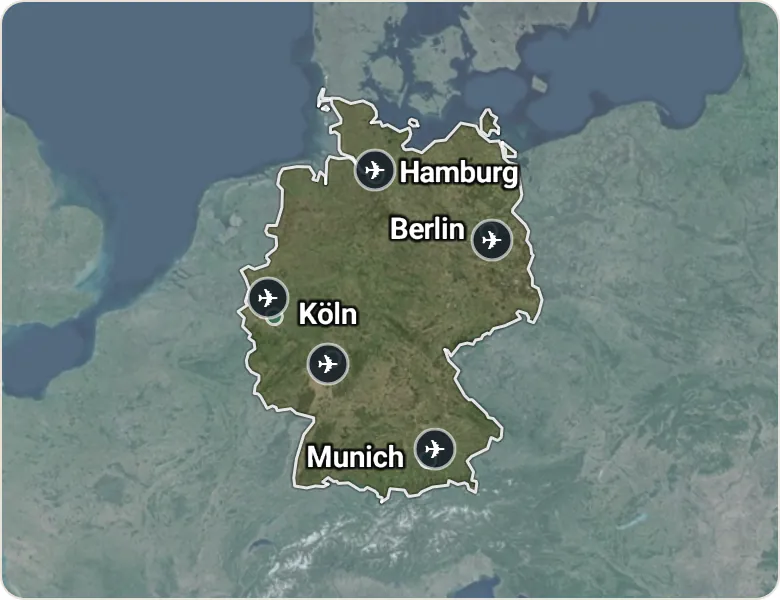
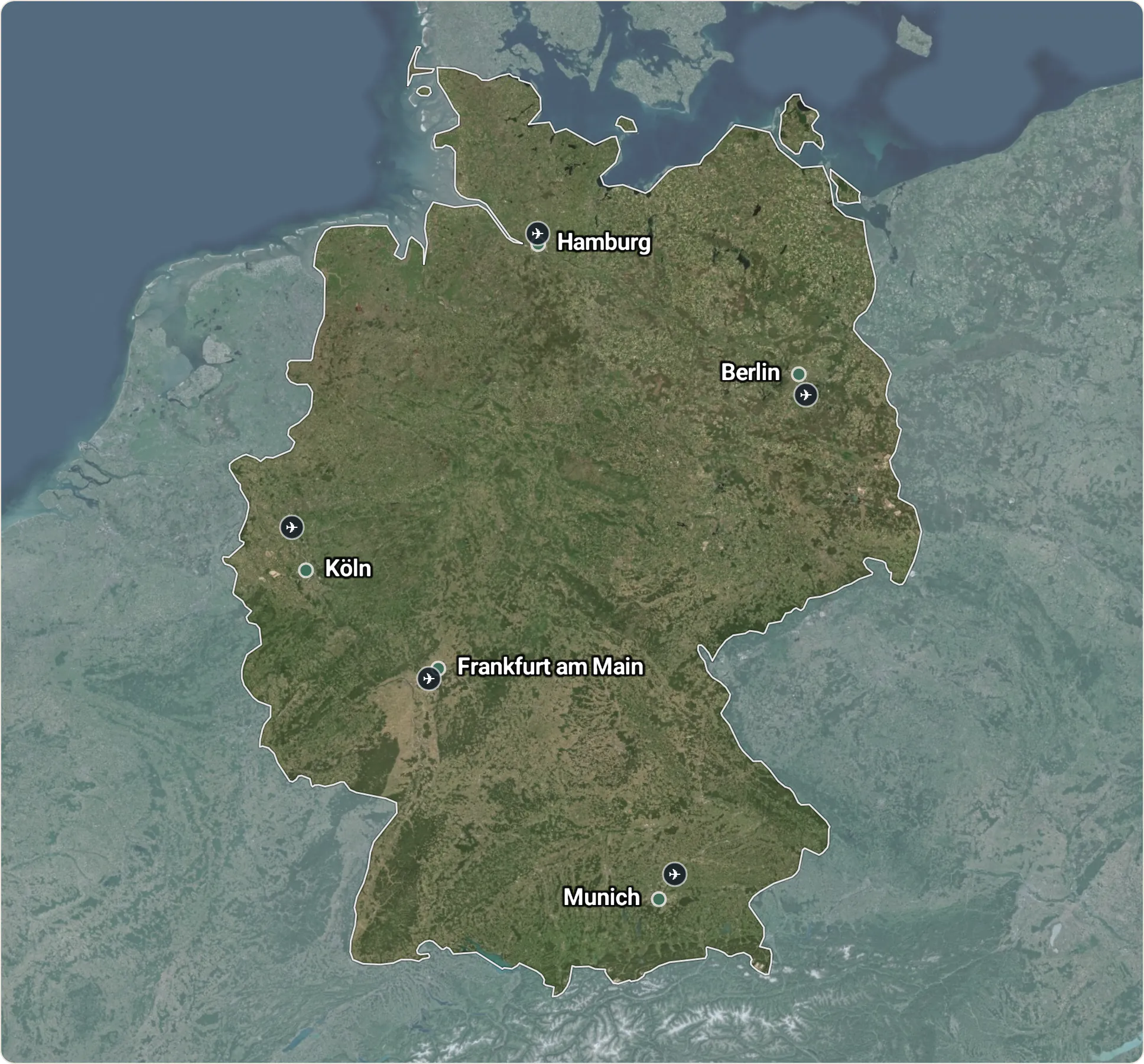
Top cities
- Berlin3.5M residents
- Hamburg1.7M residents
- Munich1.8M residents
- Köln1.2M residents
- Frankfurt am Main916K residents
Source: GeoNames


Cost of living in Germany
On the pricey side for Europe.
Germany is pricier than 32 of 41 European countries — roughly 38% above the European median of $1,715/mo.
The city you choose shifts your budget — Munich ($3,004) runs 1.5× Dresden ($1,972).
Good to know — low cost often trades against local salaries and visa options — budget for income, not just spending. Learn how we measure this →
Safety in Germany
Nothing here stands out as a concern.
Germany is safer than 27 of 41 European countries — comfortably above the European median (3.1/5).
Every hazard measured across Germany sits in a normal range.
Good to know — a calm national average can hide neighbourhood-level crime — research the specific district you would live in. Learn how we measure this →
Getting around Germany
Mobility in Germany depends on the city — Karlsruhe leads, Hamm trails.
Germany is easier to get around than 34 of 41 European countries — a notch above the European median (2.9/5).
Karlsruhe reaches 4.6 while Hamm sits at 2.8 — choose by city, not by country.
Transit reach by mode
within ~800 m · overlapsGood to know — strong airport access can coexist with weak everyday transit — check the mode you would actually use. Learn how we measure this →
Culture in Germany
Culture in Germany concentrates in its big cities — Berlin leads, Dortmund is lighter.
Germany is richer in culture than 25 of 41 European countries — a notch above the European median (3.6/5).
Berlin reaches 4.9 while Dortmund sits at 3.0 — check the specific city, not the country.
 4.9/5
4.9/5- Arts
- Theatre
- Nightlife
- Festivals
 4.1/5
4.1/5- Arts
- Theatre
- Nightlife
- Festivals
 4.1/5
4.1/5- Arts
- Theatre
- Festivals
 2025UNESCO ↗
- Cultural
- Architectural landmark
 1999UNESCO ↗
- Cultural
- Architectural landmark
 2002UNESCO ↗
- Cultural
- Architectural landmark
 1978UNESCO ↗
- Cultural
- Architectural landmark
 1999UNESCO ↗
- Cultural
- Living heritage
Good to know — a strong national culture score can be carried by one or two big cities — check the specific city, not only the country average. Learn how we measure this →
Airports in Germany
Frankfurt Airport is Germany's busiest gateway.
Germany is busier than 78 of 87 countries worldwide. It sees ~3 air passengers per resident a year — a derived figure, not itself ranked.
17 major airports handle about 217M passengers a year. Tap any to see its nearest cities and how far they are.
Good to know — passenger volume is total throughput, not direct-route breadth; a large hub can still lack flights to your region. Learn how we measure this →
Passport strength in Germany

Germany's passport ranks #4 worldwide — 175 destinations visa-free.
This is the passport you’d gain by naturalizing here — a long-horizon payoff measured in years of residency, not a signal for the move itself.
- Mobility
- #4175 destinations
- GDP reach
- #992.0% of world GDP
- Heritage
- #91,139 of 1,353 UNESCO sites
Good to know — a mobility rank counts how many destinations you can enter, not how useful they are; a strong passport can still gate the one place you care about. Learn how we measure this →
Climate in Germany
Warm summers, gentle winters.
Where most people in Germany live, it's typically -13° to 31° feels-like across the year; sunshine is moderate, topping out near 162 days in Freiburg.
Feels-like °C — where most people live, vs the city-to-city spread
Good to know— a country isn't one climate but a range; the extremes here are different cities, not the same place across seasons. Learn how we measure this →
Who thrives in Germany
Germany suits a wide range of lifestyles.
Fit is scored per lifestyle and anchored to the cities that serve each best — Park & Garden Lover leads. Pick one to see exactly where it works.
Great fit
Decent fit
Poor fit
Good to know — fit is by city, not country; a lifestyle that thrives here may only do so in one or two of its cities. Learn how we measure this →